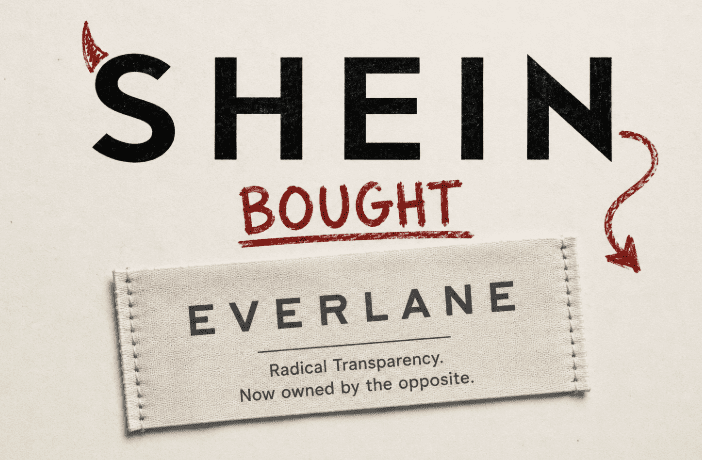
The Everlane acquisition isn’t ironic. It’s the strategy.
There’s a line from Everlane’s Instagram, posted two days before the news broke: “Better isn’t a mood. It’s a standard we refuse to lower.”
The comments are now disabled.
On May 16, 2026, Everlane’s board voted to sell the company to SHEIN for $100 million. And if you felt something drop in your stomach when you read that, you’re not being dramatic. That feeling is the correct response to what just happened.
I’ve been covering SHEIN since before most people knew how to pronounce it. I fought them when they came to my school. I’ve written about their business model, their labor practices, their greenwashing playbook. I followed them closely but I didn’t see this coming.
What Is the Everlane SHEIN Deal and Why Does It Matter?
Everlane launched in 2011 with a genuinely radical idea: what if a fashion brand just told you the truth?
Not vague sustainability language. Not a feel-good factory video. The actual numbers. Every product on Everlane’s website showed you the cost of materials, the cost of labor, the cost of transport, the markup, and the name of the factory where it was made. They called it “radical transparency” and they trademarked the phrase, because the concept was central to their identity.
Their three pillars: Know Your Factories. Know Your Cost. Always Ask Why.
For a generation of consumers who were sick of being lied to by fashion brands, Everlane felt like proof. Proof that you could build a profitable company without hiding anything. Proof that choosing where you shop could actually mean something. Proof that the alternative to fast fashion was real and accessible and didn’t require wearing a burlap sack.
Millions of people built their shopping habits and their hope around that proof.
On May 16, 2026, Everlane’s board handed all of it to SHEIN.
What Actually Happened — The Financial Reality
This deal didn’t happen because SHEIN suddenly developed a conscience. It happened because Everlane ran out of money.
By early 2026, the brand was carrying roughly $90 million in debt: a $25 million term loan from Gordon Brothers and a $65 million revolving credit facility from CIT Northbridge. L Catterton — the private equity firm backed by LVMH and the Arnault family — had invested $85 million into Everlane in 2020 at a valuation of $550 million. They are exiting through a deal that values the company at $100 million, with common stockholders receiving nothing.
In March 2026, CEO Alfred Chang and L Catterton began quietly looking for a co-investor, anyone who could inject liquidity and keep the brand alive. They found SHEIN.
Revenue had declined from an estimated $200 million around 2023 to approximately $170 million by early 2026. This is a distressed asset sale dressed up as an acquisition. And the buyer knew exactly what they were buying and why.
Who SHEIN Actually Is
Before we talk about what this acquisition means, let’s talk about who just bought one of ethical fashion’s most trusted brands.
An undercover Channel 4 investigation sent a reporter into two SHEIN supplier factories in Guangzhou, China. Workers were earning as little as 3 cents per garment for 18-hour days with no weekends and one day off per month. Workers were docked two-thirds of their daily wages for making a single mistake. One worker described the reality plainly: “There are no Sundays here.” Women in one factory were filmed washing their hair on their lunch breaks — not as a luxury, but because it was the only window of time they had outside of work.
Laboratory testing conducted for Bloomberg News found that garments shipped to the U.S. by SHEIN were made with cotton from China’s Xinjiang region — where the U.S. State Department has documented genocide and crimes against humanity against Uyghur Muslims. Imports of Xinjiang cotton are banned under U.S. law. When Bloomberg confronted SHEIN with those results, SHEIN didn’t dispute the test results or say whether it uses cotton from Xinjiang. They issued a statement about compliance and moved on.
SHEIN’s own 2024 supply chain audit found cases of child labor and forced labor within its supplier network. Speaking before the U.K. Parliament’s Select Committee, committee chair Liam Byrne told SHEIN’s representatives: “You’ve given us almost zero confidence in the integrity of your supply chains.”
In February 2026, the Texas Attorney General filed a lawsuit alleging that SHEIN sold clothing laced with toxic chemicals and routed American consumers’ personal data to the Chinese government.
Between 2022 and 2023, SHEIN nearly doubled its carbon dioxide emissions, making it the biggest polluter in the fast fashion industry, according to Yale Climate Connections. The company ships individual packages by air from China to 150 countries. Every order. Every time. Because ocean freight is slower and slow is the one thing SHEIN’s model cannot afford to be.
This is who now owns “radical transparency.”
SHEIN Just Bought the Brand That Was Supposed to Be the Alternative to SHEIN
That’s the sentence. Sit with it.
The brand that published the exact cost of your T-shirt — materials, labor, transport, markup, factory name — is now owned by the brand that stonewalled a parliamentary committee about whether it uses forced labor. The brand whose three pillars were Know Your Factories, Know Your Cost, Always Ask Why is now an asset on the balance sheet of a company whose own supply chain audit turned up child labor and whose cotton tested positive for Xinjiang sourcing.
Everlane’s last post said “Better isn’t a mood. It’s a standard we refuse to lower.”
SHEIN’s response was $100 million.
And here’s what makes this more than ironic: SHEIN didn’t stumble into this acquisition. They chose it. When SHEIN’s labor and environmental practices went viral in 2023, the brand’s net favorability among Gen Z dropped nearly 20 points in a single year. They felt that. So they have spent the years since running a quiet legitimacy campaign — paid influencer factory tours designed to look like organic content, fashion school scholarships engineered to attach student credibility to the brand name, and now this: $100 million for a company whose customers spent a decade trusting it on exactly the issues SHEIN is radioactive on.
SHEIN has a strategic incentive to absorb the U.S.-brand asset ahead of an IPO complicated by U.S.-China trade frictions. Everlane gives them two things their core platform cannot buy directly: a loyal American customer base and a sustainability halo.
SHEIN isn’t buying Everlane’s clothes. They’re buying your trust in Everlane. The decade of goodwill that Everlane’s customers built — that’s the asset that just transferred. The 3-cents-per-garment workers didn’t change. The 18-hour days didn’t change. The Xinjiang cotton didn’t change. The only thing that changed is that SHEIN now has a San Francisco address and a radical transparency trademark sitting on its books.
Everlane’s Record Was Always More Complicated Than the Marketing
It’s worth being honest about something: Everlane’s “radical transparency” was never the full picture.
In March 2020, Everlane laid off approximately 290 employees — including the majority of the customer experience team — just four days after union organizers asked management to formally recognize their union. Workers described being locked out of their accounts without warning. Senator Bernie Sanders called it union busting. Everlane attributed it entirely to COVID-19.
The brand pledged to eliminate virgin plastic from its supply chain by 2021. The deadline slipped. The brand published factory names but not always raw material sourcing. Watchdogs documented greenwashing criticism for providing supply chain information selectively, with limited third-party verification.
This is not to say Everlane was fraudulent. They pushed the industry genuinely forward. They made consumers ask harder questions. They proved that transparency as a value proposition could build a real business. But the gap between what Everlane marketed and what Everlane actually delivered was always wider than the brand wanted to admit.
The customers who believed in what Everlane was trying to be deserved to know that. They definitely deserved better than this exit.
So What Do You Do When Integrity Is for Sale?
Honestly? It’s okay to feel sick about this.
Everlane was supposed to be proof that it could work. That a fashion brand could be honest, and survive. That the choices consumers made with their money actually added up to something. A lot of people built real hope around that idea.
And now SHEIN owns it.
So if you’re sitting here thinking “what’s even the point” — that’s not a naive reaction. That’s an accurate one. The good guy got bought. The system absorbed the alternative and turned it into a marketing asset. This is genuinely bleak.
But here’s the thing that matters: SHEIN spent $100 million on Everlane specifically because your values are worth something. They didn’t buy a struggling DTC brand for the inventory. They bought it because ethical fashion consumers represent a market they cannot reach any other way. Because the trust Everlane’s customers built over a decade has real, quantifiable monetary value.
They know your integrity matters. That’s the whole reason they’re trying to acquire it.
Which means it isn’t actually for sale. It only transfers if you let it.
Here’s What Doesn’t Get Acquired
The secondhand economy has no board of directors. The thrift store, the consignment shop, the vintage market, the clothing swap, the Depop listing, the friend who passes her jacket to you when she’s done with it — none of that infrastructure can be purchased by a company trying to clean up its image before an IPO. It belongs to the communities that use it. That’s not a slogan. It’s a structural difference.
Beyond that: stop treating brand loyalty as a substitute for values. Everlane taught a generation that shopping from the right company was enough. It wasn’t. The deeper practice is knowing what you already own, wearing it longer, buying less of it, and being skeptical of any brand — including the next one that arrives with a transparency report and a compelling origin story.
Look for the certifications that actually mean something. Ask where the cotton came from, not just where the shirt was sewn. Support brands small enough that a private equity firm can’t quietly sell them to SHEIN while you’re not looking.
And tell people what just happened. Not as a lecture. Just as information. The Everlane acquisition is the clearest possible illustration of exactly how SHEIN operates — not by changing, but by buying the appearance of having changed. That story is worth sharing.
SHEIN wins when the news cycle moves on and everyone forgets. It loses when people remember and tell each other exactly what it just did.
By the way SHEIN, I’ll still keep writing about you, until you change your ways or disappear.
Follow me on Instagram & TikTok @LexySilverstein.