
We’ve been sold a story about sustainability that puts all the pressure on us. Shop better. Recycle harder. Calculate your carbon footprint. Feel guilty about every purchase.
But here’s what that story leaves out: the climate crisis wasn’t caused by you buying a dress. It was engineered by fossil fuel companies that knew for decades exactly what damage they were causing, and chose profit over the planet anyway.
The Make Polluters Pay campaign is working to change who pays for that damage. And if you care about sustainable fashion, this matters more than you might think.
The Climate Cost Hidden in Your Closet
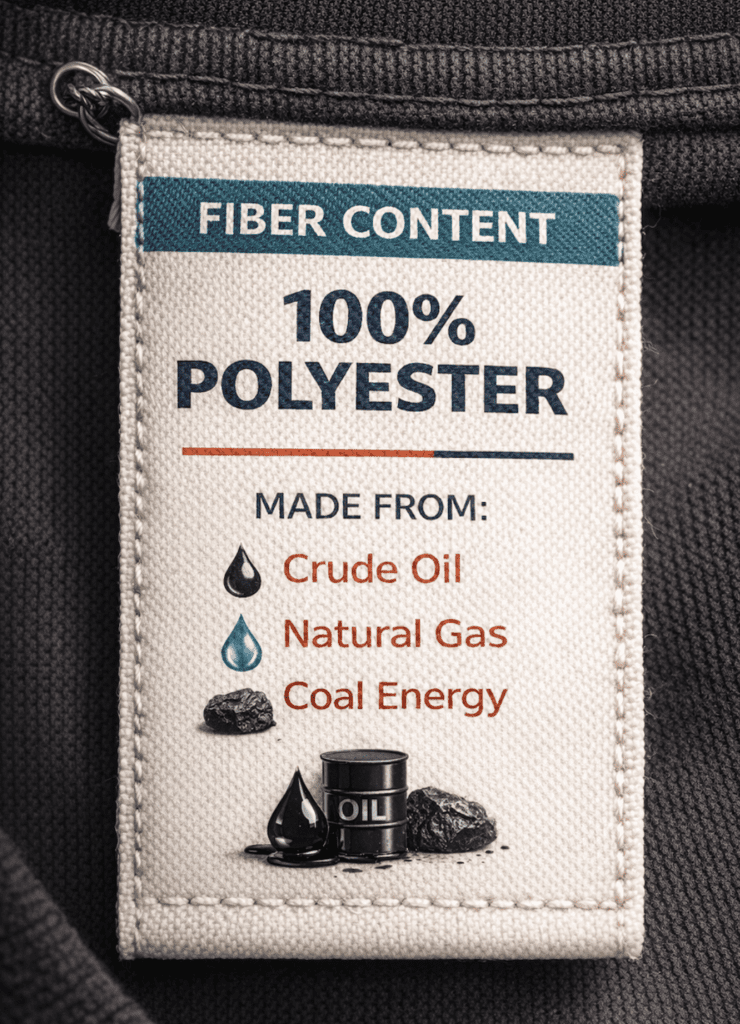
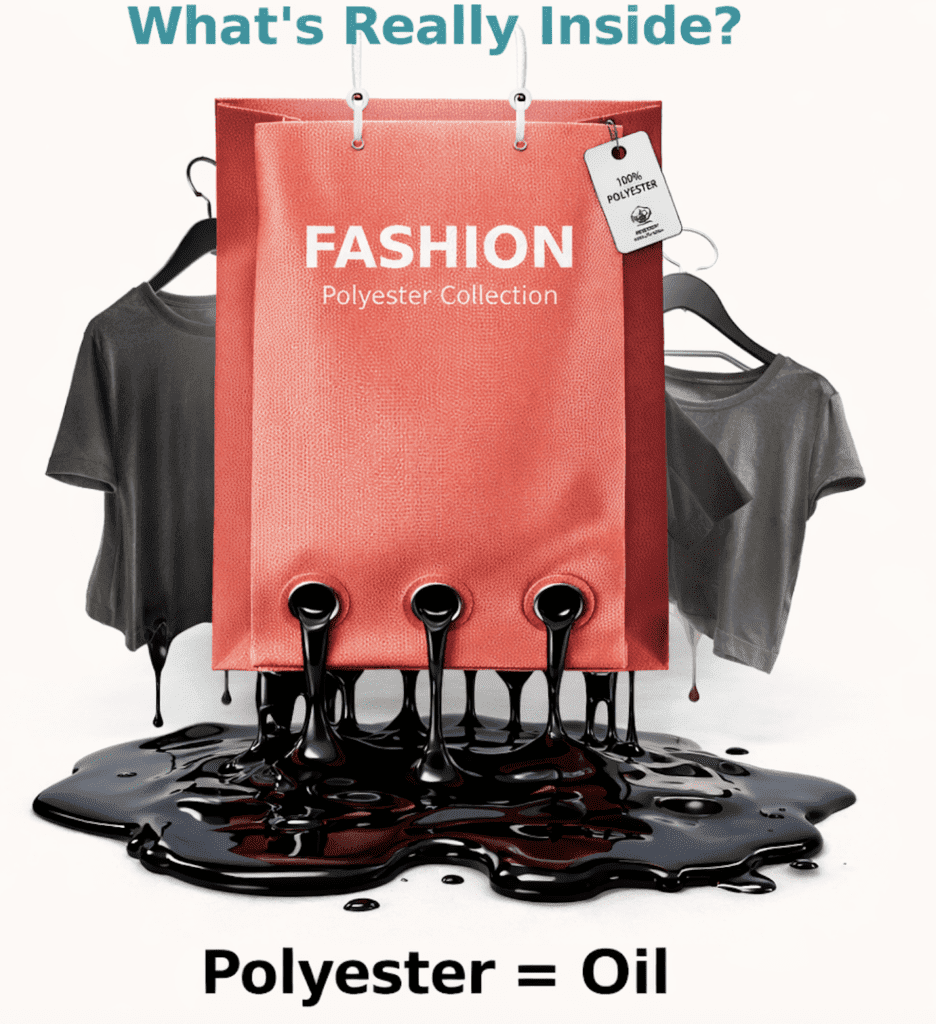
Before we talk about accountability, we need to talk about something the fashion industry doesn’t advertise: your clothes are made from oil.
Polyester, the most widely used fabric in the world, is literally plastic. It’s derived from petroleum, the same crude oil that powers cars and heats homes. In 2022, synthetic fibers made up 65% of all textile production globally. That’s not just a statistic. That’s the business model.
Here’s how deep this goes:
Production: Making polyester requires petroleum and natural gas as raw materials. The energy-intensive process of converting these fossil fuels into fabric emits volatile chemicals and greenhouse gases. In 2015 alone, polyester production for textiles generated over 700 million tons of CO2, roughly equivalent to Mexico’s entire annual emissions.
Energy: Textile factories run on fossil fuels. From yarn preparation to dyeing and finishing, the industry consumes massive amounts of coal, oil, and gas to power machinery, heating systems, and production lines. Material production accounts for 38% of the fashion industry’s total greenhouse gas emissions.
Transportation: Global supply chains depend on fossil fuel-powered shipping. Fast fashion brands that drop thousands of new styles annually require constant international freight movement, adding layers of carbon emissions.
Cost structure: Here’s the part that connects everything – polyester costs half as much per kilo as cotton, largely because fossil fuel extraction is subsidized by governments worldwide. Cheap synthetic fibers enable the fast fashion business model. Without artificially low oil prices, the entire system would look different.
When we talk about fast fashion, we’re really talking about fossil fuel fashion. The two are inseparable.
What Is Make Polluters Pay?
Make Polluters Pay is a campaign focused on holding fossil fuel companies financially accountable for climate damage they knowingly caused.
The concept is straightforward: if you make a mess, you pay to clean it up.
For decades, major oil and gas companies conducted internal research showing that their products would destabilize the climate. Instead of changing course or warning the public, they funded misinformation campaigns, lobbied against climate policy, and marketed themselves as environmental leaders.
If this sounds familiar, it should. It’s the exact playbook Big Tobacco used for decades, conducting internal research proving their products caused cancer, then spending billions to manufacture doubt, fund fake science, and lie to the public while people died. Eventually, that deception caught up to them. Tobacco companies were held legally and financially accountable for the harm they caused and the lies they told.
The fossil fuel industry followed the same script. Internal documents from the 1950s and 60s show companies like Exxon understood the climate consequences of burning fossil fuels. They knew, they lied, and they profited while the rest of us paid the price.
Meanwhile, communities everywhere are paying the actual costs: flooded homes, deadly heat waves, infrastructure failures, skyrocketing insurance premiums, health crises, wildfire smoke that closes schools and makes outdoor activities dangerous.
Make Polluters Pay exists to shift those costs back to the companies responsible, the same way tobacco companies were eventually forced to pay for the damage they caused.
“When the fossil fuel industry comes into our state and destroys our climate, they have to pay for that,” said Cassidy DePola, Communications Director for the campaign.
I spoke with Cassidy on a recent episode of The Lexy Show: Fashion That Gives a Damn about what accountability looks like in practice and why it matters for fashion.
Three Strategies for Climate Accountability
The campaign operates through three main approaches:
1. Climate Superfund Legislation
These laws work like existing toxic waste cleanup programs, but applied to climate damage. Fossil fuel companies that contributed the most to historical emissions pay fees into public funds. States then use that money for climate resilience projects: flood protection, wildfire prevention, heat mitigation infrastructure, home weatherization, clean energy transitions.
Vermont became the first place worldwide to pass Climate Superfund legislation in May 2024. New York followed later that year. Similar bills are now advancing in over a dozen states.
This isn’t symbolic, it’s practical funding that creates real infrastructure changes. For fashion brands trying to decarbonize supply chains or invest in renewable energy, this type of state-level funding could support the transition away from fossil fuel-powered production.
2. Climate Liability Lawsuits
These cases argue that fossil fuel companies should be held legally accountable for decades of deception. Internal documents show many companies understood the link between fossil fuels and climate change as early as the 1950s, yet worked to cast doubt on climate science and delay action.
The parallel to Big Tobacco is intentional. Tobacco companies were eventually held responsible for lying about health risks. These lawsuits seek the same accountability for fossil fuel companies that misled the public while knowingly causing widespread harm.
3. Ending Fossil Fuel Subsidies
Despite record-breaking profits, oil and gas companies continue receiving massive subsidies and tax breaks. Taxpayers foot the bill for disaster recovery, infrastructure repair, health impacts from pollution, and insurance bailouts—while the companies that caused the damage pay nothing.
Make Polluters Pay works to end these subsidies and redirect public money toward solutions that actually serve communities and enable industries like fashion to transition to cleaner production.
Why We’ve Been Blaming Ourselves Instead of Big Oil
One of the most revealing parts of my conversation with Cassidy was learning where the concept of a personal “carbon footprint” actually came from.
It wasn’t created by climate activists or environmental scientists.
It was popularized by fossil fuel industry marketing campaigns, specifically designed to shift blame from corporations to individual consumers.
“They made it all about us… when really that’s a minor detail compared to how much ExxonMobil and Shell are emitting every day,” Cassidy explained.
That strategy worked brilliantly. Today, people feel intense guilt over buying a polyester shirt or using a plastic bag, while the largest polluters in the world continue operating with minimal accountability.
This manufactured guilt keeps us focused on individual purchasing decisions rather than systemic change. It’s exhausting, it’s isolating, and ultimately, it’s ineffective at solving the actual problem.
Personal action still matters. But guilt-driven sustainability without systemic accountability is a dead end.
What This Actually Means for Fashion
Fashion doesn’t exist outside the fossil fuel economy. The connection is direct, material, and financial.
73% of textiles will be fossil fuel-derived by 2030 if current trends continue. We’re moving toward a future where nearly three-quarters of all clothing is literally made from oil and gas.
The fashion industry uses 1.35% of global oil consumption just for synthetic fiber production—more than Spain’s entire annual oil use.
Polyester production is projected to nearly double by 2030, reaching emissions equivalent to twice Australia’s annual greenhouse gas output.
Right now, fashion brands face an impossible situation: they’re expected to decarbonize supply chains while competing against artificially cheap fossil fuel-based materials. Polyester costs half as much as cotton largely because oil extraction is heavily subsidized.
When fossil fuel companies are held accountable and subsidies end, several things become possible:
Level playing field: Sustainable materials become cost-competitive when fossil fuels aren’t artificially cheap. Brands can make better choices without sacrificing affordability.
Infrastructure investment: Climate Superfund money could support renewable energy transitions in textile manufacturing regions, making it feasible for factories to shift away from coal and gas power.
Supply chain transformation: When the true cost of fossil fuel extraction is reflected in material prices, circular business models, textile-to-textile recycling, and regenerative fiber production become economically viable at scale.
Reduced greenwashing: When companies face real accountability for climate impacts, vague sustainaility marketing becomes legally risky. Transparency improves.
Consumer pressure works differently: Instead of asking individual shoppers to perfectly navigate an intentionally confusing system, accountability shifts to the corporations that designed that system.
Sustainable fashion works best when paired with systemic accountability. Right now, we’re asking consumers to carry weight that should be distributed across the entire supply chain and held by the companies that profited from creating climate chaos.
Climate Change Is Already Here
Climate impacts are often framed as future scenarios, but they’re shaping daily life right now.
Higher utility bills from extreme temperatures. Rising food prices linked to crop failures and climate disasters. Insurance companies pulling coverage from wildfire and flood zones, or raising premiums to unaffordable levels. Schools closing because of heat or wildfire smoke. Increased respiratory illness. Growing climate anxiety, especially among young people who see their futures narrowing.
Children born today face significantly higher lifetime costs because of climate impacts. These aren’t accidents or acts of nature. They’re predictable results of documented corporate decisions made decades ago.
For textile workers in places like Bangladesh, Pakistan, and India, climate impacts already mean devastating floods destroying cotton crops, deadly heat waves in factories without adequate cooling, and climate-driven displacement forcing migration.
Why the Big Tobacco Comparison Matters
Make Polluters Pay draws direct inspiration from the Truth campaign that exposed Big Tobacco.
The turning point wasn’t just regulation, it was public understanding. Once people grasped that tobacco companies knew their products were lethal and lied anyway, their social license to operate collapsed. The industry went from glamorous to pariah.
The same pattern applies here. When the public understands that fossil fuel companies conducted internal research in the 1950s showing their products would cause catastrophic climate change, then spent decades funding misinformation and lobbying against solutions, all while making record profits, accountability stops sounding radical and starts sounding reasonable.
Internal documents prove they knew. Marketing campaigns show they lied. Lobbying records demonstrate they blocked policy solutions. The receipts exist.
You Don’t Have to Be Perfect
If this feels overwhelming, Cassidy’s advice is grounding: you don’t have to be perfect. Shame doesn’t drive change.
Learn from trusted sources. Talk about these issues beyond social media. Remember that individual actions matter most when they connect to collective accountability.
Keep thrifting. Keep repairing clothes. Keep supporting brands doing real work toward sustainability. Those actions are valuable.
But also recognize that your imperfect personal choices are not the problem. The problem is a handful of corporations that engineered a system dependent on fossil fuels, lied about the consequences, and continue profiting while communities pay the costs.
Demanding accountability from those corporations isn’t radical—it’s reasonable. It’s overdue. And it’s necessary if we want fashion, along with every other industry, to have a livable future.
Get Involved
Make Polluters Pay is active on Instagram (@PollutersPay), TikTok (@MakePollutersPay), and at makepolluterspay.net.
Track Climate Superfund legislation in your state. Contact representatives. Support organizations working on these campaigns.
Sustainability isn’t just about consuming better. It’s about demanding better—from the industries that caused the crisis in the first place.
Because the truth is this: you can thrift every piece of clothing you own, never buy polyester again, repair everything until it falls apart, and it still won’t solve the climate crisis if the companies extracting fossil fuels face zero consequences for the damage they’ve caused.
Real change requires both. Personal action matters. Systemic accountability matters more.
FOLLOW ME ON MY SOCIALS

You can email me at LexySilverstein@gmail.com
Related Posts