Let’s play a quick game. I say “sustainable fashion,” and you picture what, exactly? Pricey linen dresses? Scratchy hemp shirts? A grid of tiny certification logos no one actually understands? Or maybe NOTHING came to mind because you don’t know enough about it. If your brain just spiraled into confusion, welcome, you’re in the majority.
The truth is, as words like “eco,” “green,” and “conscious” got absorbed into marketing, the myths started multiplying. Some of them are mildly annoying. Others? They stop people from making choices that truly align with their values, budgets, and lifestyles.
This isn’t about calling out your past purchases or forcing you into a perfect wardrobe. It’s about clarity. It’s about giving you the tools to shop without anxiety and build a closet that feels good on your body, your wallet, and the planet.
Let’s get into the biggest myths I hear all the time and what actually matters.
Myth #1: “Sustainable fashion is always more expensive.”
The assumption: If it’s eco-friendly, it must cost as much as your rent. ☹️
The reality: Sustainable fashion isn’t about spending more. It’s about buying better.
But before we even get into cost-per-wear, I think we need to change our mindset. When you look at clothing short term, everything feels expensive. When you look at it long term, everything changes.
So let’s walk through a real example.
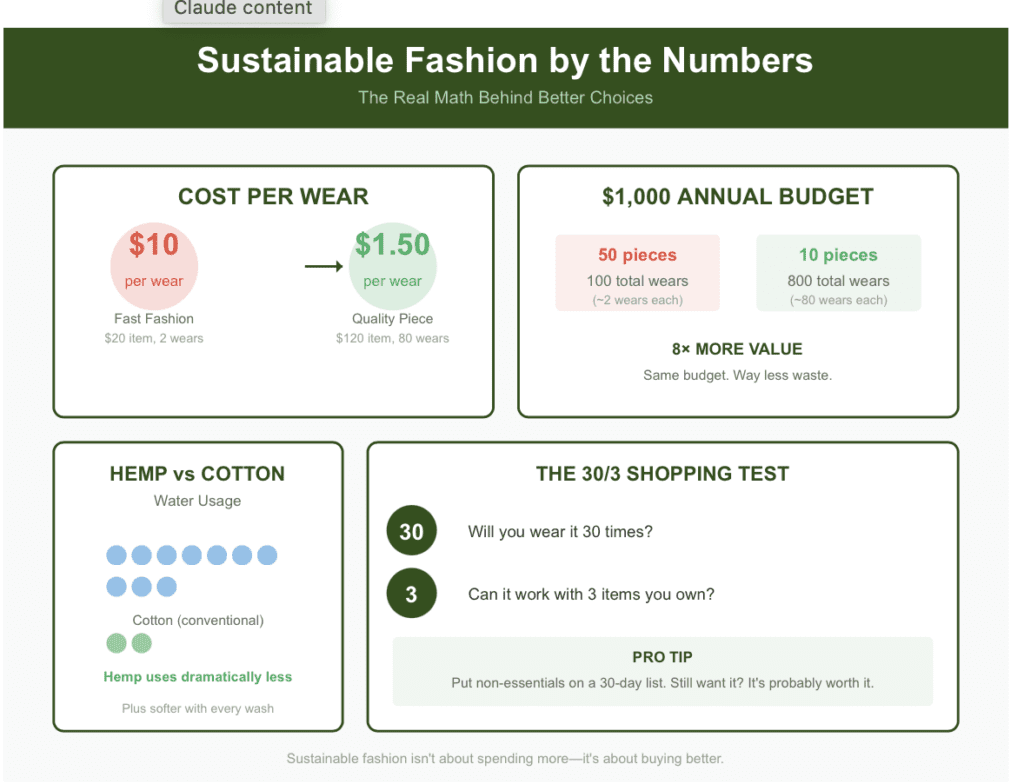
A $20 fast-fashion top that falls apart after two wears costs you $10 per wear.
A well-made $120 shirt you wear 80 times over a couple of years? That comes out to about $1.50 per wear. When you’re done with it, you can donate it, resell it, pass it along to a friend, or give it a second life in someone else’s closet. Suddenly the “expensive” shirt is the budget option.
Now let’s zoom out even bigger.
What if you spend $1,000 on fast-fashion pieces through the year?
At an average of $20 per item, that’s about 50 pieces. Most of those items last a few washes, lose their shape, or sit in the back of your closet because they were impulse buys. If you wear each one twice, you’re getting maybe 100 total wears out of the whole $1,000.
Now imagine spending the same $1,000 on ten well-made pieces, each around $100.
If each of those pieces lasts for years and gets 80 wears, you’re getting 800 wears total. Same budget, eight times more value, way less waste.
Let’s talk cost-per-wear.
- Fast fashion: roughly $10 per wear.
- Quality pieces: closer to $1 or $2 per wear.
The math isn’t just different. The mindset is. Sustainable fashion isn’t about buying pricier things. It’s about investing in clothes that last, feel better, and don’t end up in a landfill after a weekend.
Try this: For anything that’s not a must, put it on a 30-day list. If you still want it after a month and can name three outfits and two ways to style it for work and play, it’s probably a smart buy.
Myth #2: “Eco fabrics aren’t stylish.”
The assumption: Sustainable fashion = beige, shapeless, back-to-the-land energy.
The reality: We left that narrative behind years ago.
Lower-impact fabrics today are genuinely beautiful to wear.
- TENCEL™ Lyocell drapes like silk and is made from wood pulp in a closed-loop system that recycles over 99% of solvents.
- Recycled nylon gives ultra-sleek performance pieces and reduces reliance on virgin petroleum.
- Hemp blends soften with every wash and require dramatically less water to grow (UN FAO).
- Organic cotton avoids synthetic pesticides and shows up in premium denim, crisp poplin, and structured twill (GOTS).
Designers at every level, from small independents to luxury houses, are proving sustainability and style aren’t opposites.
Stella McCartney’s gowns, Mara Hoffman’s tailoring, Reformation’s silhouettes, and countless independent designers are building entire collections on lower-impact textiles.
Myth #3: “All eco labels mean the same thing.”
The assumption: A little green leaf icon = good for the planet.
The reality: Certifications focus on completely different issues, and not all logos are third-party verified.
Quick guide:
- GOTS: Organic fibers plus strict rules on processing and labor basics.
- OEKO-TEX® STANDARD 100: Tests finished fabrics for harmful substances.
- Fairtrade/Fair Trade: Ensures fair pay and safer conditions.
- bluesign®: Focuses on cleaner chemical inputs and responsible manufacturing.
- Regenerative Organic Certified® (ROC): Soil health + farm-level welfare + social fairness.
- Cradle to Cradle Certified®: Circularity and product-level material health.
A real certification always has a license number you can verify. If a brand won’t share proof, assume it’s marketing.
Here’s a deep dive if you’d like to read more from another blog of mine called, Truth About Fashion Certifications.
Myth #4: “Sustainable clothes fall apart.”
The assumption: Eco-friendly = fragile or “too delicate for real life.”
The reality: Durability is about design and construction, not the sustainability label.
Some of the strongest fibers in fashion including hemp, wool, high-grade organic cotton, recycled nylon are staples of sustainable collections. What usually fails in cheap garments are the seams, stitching, zippers, or fabric finishing.
What to look for:
- Tight weaves/knits
- Reinforced stress points
- Quality hardware
- Clean interior finishing
- Fabric weight that matches intended use
Care matters too. Washing cold, line drying, and avoiding aggressive cycles can double (or triple) a garment’s lifespan.
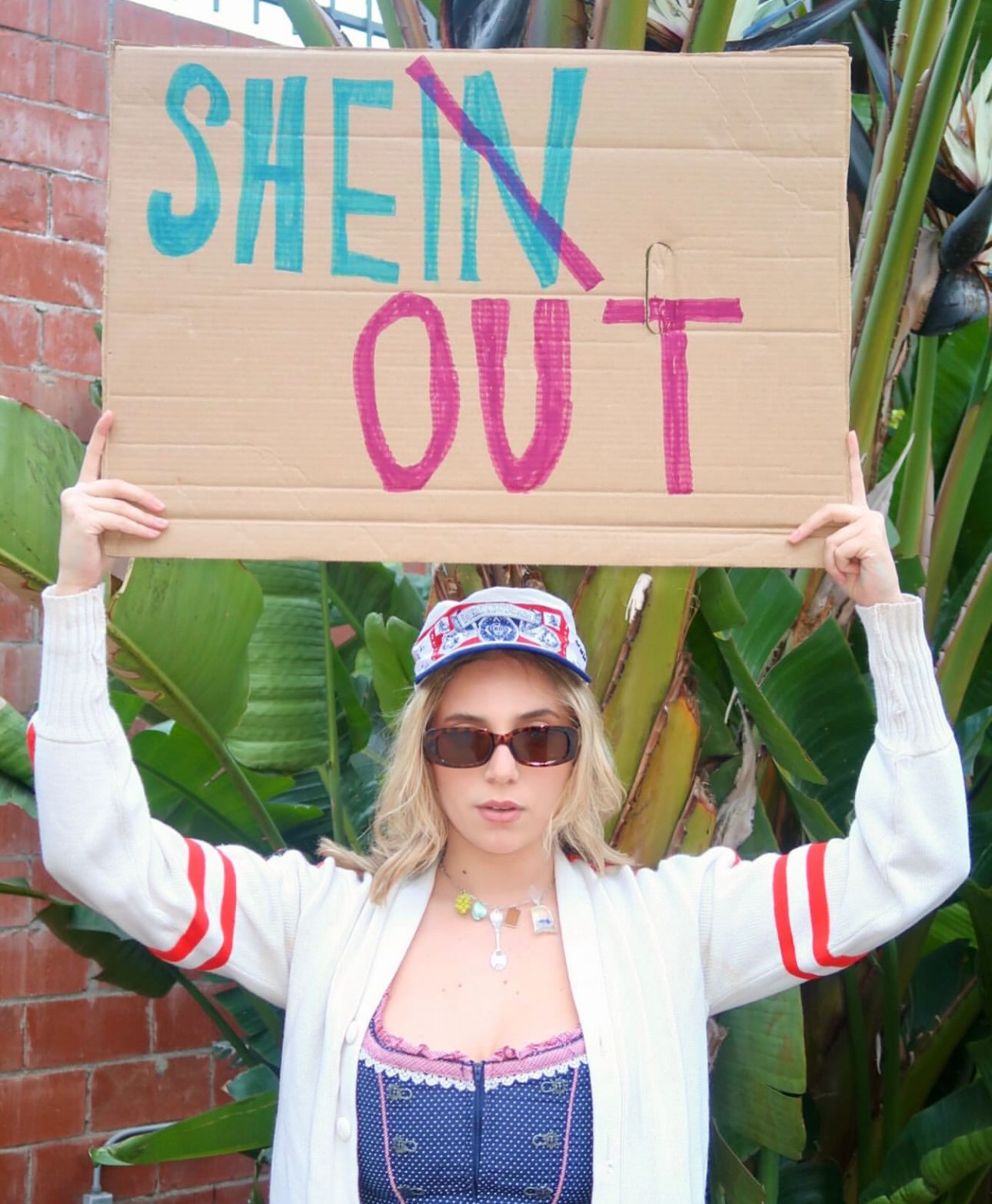
Why Never SHEIN (and ultra fast fashion like them): And for anyone wondering why ultra-fast-fashion pieces, like those from SHEIN, fall apart so quickly, well, it’s usually not the fabric itself, it’s the way the clothes are made. Most ultra-cheap items are sewn with very low stitch counts, weak thread, and almost no reinforcement at seams or stress points. The polyester they use is often low grade with shorter fibers, so it pills, thins, and loses shape fast. The garments break down on your body because of rushed, low-quality construction, even though the synthetic fibers themselves can last for decades in a landfill.
Myth #5: “Sustainable = just the fabric.”
The assumption: If the hangtag says organic or recycled, mission accomplished.
The reality: Sustainability is whole-supply-chain thinking.
That means:
- Safer chemistry
- Fair wages and safe working conditions
- Lower-impact dyeing
- Energy efficiency
- Design for durability
- Repair programs
- Take-back or recycling pathways
- Transparent reporting
A recycled polyester top that lasts six wears isn’t sustainable in practice. A sturdy organic cotton shirt you love and repair over five years? Much closer.
Myth #6: “If it’s vegan leather, it’s automatically sustainable.”
The assumption: No animals = good for the planet.
The reality: A lot of vegan leather is just polyurethane or PVC — plastic-based materials that shed microfibers, crack quickly, and won’t biodegrade.
There are exciting next-gen options like cactus leather, apple leather, mycelium, and pineapple fiber, but “vegan” on a tag doesn’t automatically equal “low impact.” You have to look at what the material is actually made of and how long it’s built to last.
Smart Approach:
Choose the vegan alternative that’s built to hold up, and choose long-term wear over short-term trends. And if you want to shop smarter, here’s what helps:
- Check the fiber content label. If it just says “vegan leather” with no explanation, it’s usually PU or PVC. Look for materials that clearly identify cactus, apple, pineapple, mushroom, or recycled content.
- Feel the material in your hands. Higher-quality vegan leathers feel flexible, dense, and durable. Cheaper ones feel thin, plasticky, or overly shiny and will crack much faster.
- Look for brands that explain their sourcing. If a brand is using a next-gen material, they’ll tell you. Transparency is a good sign the material is actually lower impact.
- Consider lifespan before buying. Ask yourself: Will this bag, jacket, or shoe hold up for years, or is it going to peel in a season? Sustainability is about how long something lasts, not just what it’s made from.
- Prioritize recycled or bio-based options. Cactus leather, apple leather, and recycled PU tend to have lower impacts than virgin plastics.
- Buy timeless silhouettes rather than trend pieces. Even the best vegan leather isn’t sustainable if it’s something you only wear twice. Go for shapes and colors you’ll want for years.
- Repair and condition when possible. Some vegan leathers respond well to gentle conditioning or patch repairs, which keeps them in rotation longer and reduces waste.
Myth #7: “Small brands can’t be sustainable without certifications.”
The assumption: No logos = not trustworthy.
The reality: Certifications are expensive, especially for small artisans and global-south makers.
Some of the most ethically run brands on earth operate without a single certification but provide deep transparency about materials, wages, and production.
Instead of looking for a logo, ask:
- Who made this?
- How were they paid?
- Where were materials sourced?
- What happens to offcuts or deadstock?
Specific answers = real accountability.
Myth #8: “My choices don’t matter.”
The assumption: The fashion industry is too big to influence.
The reality: Consumer demand shapes what brands make, promote, and prioritize. Every time you choose durable clothing, repair what you own, or ask for transparency, you’re adding pressure where it counts.
Policy drives systemic change, but consumer behavior fuels it. Both levers matter.
How to shop smarter (and feel calmer doing it)
- Use the 30/3 test. Will you wear it 30 times? Can it work with 3 items you already own?
- Verify certifications in 60 seconds. Real ones have traceable numbers. Quick Google check.
- Fix your laundry habits, not just your closet. Cold wash. Line dry. Microfiber filter or bag for synthetics.
- Keep a running wardrobe list. When a sale comes, shop the list, not the dopamine hit.
- Tailor secondhand. Fit is the quiet hero of sustainability. A $30 thrifted blazer + $20 tailoring feels like a $300 piece.
Frequently Asked Questions
Is sustainable fashion always more expensive?
No, sustainable fashion isn’t about buying pricier things. It’s about investing in clothes that last, feel better, and don’t end up in a landfill after a weekend.
Do all eco labels mean a piece of clothing is automatically good for the planet?
Certifications focus on completely different issues, and not all logos are third-party verified. Here is a quick guide to some of the good ones and what they mean:
- GOTS: Organic fibers plus strict rules on processing and labor basics.
- OEKO-TEX® STANDARD 100: Tests finished fabrics for harmful substances.
- Fairtrade/Fair Trade: Ensures fair pay and safer conditions.
- bluesign®: Focuses on cleaner chemical inputs and responsible manufacturing.
- Regenerative Organic Certified® (ROC): Soil health + farm-level welfare + social fairness.
- Cradle to Cradle Certified®: Circularity and product-level material health.
Do sustainable clothes fall apart?
Durability is about design and construction, not the sustainability label. Some of the strongest fibers in fashion including hemp, wool, high-grade organic cotton, recycled nylon are staples of sustainable collections. What usually fails in cheap garments are the seams, stitching, zippers, or fabric finishing.
Is vegan leather automatically sustainable?
No. A lot of vegan leather is just polyurethane or PVC — plastic-based materials that shed microfibers, crack quickly, and won’t biodegrade. There are exciting next-generation options like cactus leather, apple leather, mycelium, and pineapple fiber, but “vegan” on a tag doesn’t automatically equal “low impact.” You have to look at what the material is actually made of and how long it’s built to last.
How can I make sure vegan leather is sustainable?
Choose the vegan alternative that’s built to hold up, and choose long-term wear over short-term trends. And if you want to shop smarter, here’s what helps:
- Check the fiber content label.
- Feel the material in your hands.
- Look for brands that explain their sourcing.
- Consider lifespan before buying.
- Prioritize recycled or bio-based options.
- Buy timeless silhouettes rather than trend pieces.
- Repair and condition when possible.

You can email me at LexySilverstein@gmail.com
Related Posts